Don Pedro
Much Ado About NothingDon Pedro, the prince of Arragon, enters Messina as both a political presence and a force of social animation. His arrival promises celebration, courtship, and renewed fellowship, but his authority also magnifies the consequences of error: when he accepts Don John’s manufactured evidence against Hero, private deceit becomes public disgrace. Yet Don Pedro is not merely an agent of confusion. He repeatedly brings people together, engineers the transformation of Benedick and Beatrice, and participates in the eventual recognition of the slander that has damaged Leonato’s family.
Identity and Introduction
Don Pedro is announced as a powerful visitor approaching Messina, where Leonato learns that the prince will arrive that night. The Messenger reports that he is already close, having been less than three leagues away, making his entrance feel immediate and consequential rather than ceremonial. When he appears, he is accompanied by Don John, Claudio, Benedick, and Balthasar, a company that joins rank, friendship, rivalry, and concealed hostility in a single public arrival.
His greeting to Leonato is edged with playful irony. He says that Leonato has come to meet his trouble, contrasting the world’s habit of avoiding expense with Leonato’s willingness to encounter it. The remark presents Don Pedro as a speaker who turns hospitality and obligation into wit, but it also establishes the pressure his presence places on Leonato’s household: the prince’s visit brings not only honor and festivity but demands, schemes, and emotional disturbance.
Don Pedro’s position gives his judgments unusual force. Claudio’s love for Hero is not treated as a purely private impulse once the prince takes an interest in it. Don Pedro affirms that Hero is worthy of Claudio’s love, and his brief blessing helps convert Claudio’s uncertain passion into a socially legible courtship. His authority therefore operates through endorsement, arrangement, and the power to make a personal desire appear honorable.
Courtship and Social Mediation
Don Pedro’s first important intervention in Claudio’s romance is practical and theatrical. Claudio fears that his passion may change, but Don Pedro answers that, if Claudio loves Hero, she is well worthy of him. Later, when Claudio and Hero’s marriage is being prepared, Don Pedro promises that the intervening week will not pass dully. He undertakes what he calls one of Hercules’ labours: bringing Benedick and Beatrice into a mountain of affection for one another.
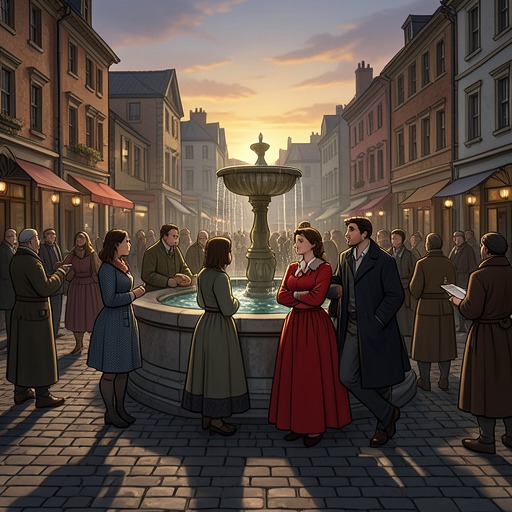
This plan reveals Don Pedro’s pleasure in arranging other people’s lives. He does not simply advise Benedick and Beatrice to reconsider their hostility; he proposes to fashion a match through coordinated assistance from Claudio and Leonato. Leonato agrees to help even at the cost of ten nights’ watching, while Claudio’s participation turns the scheme into a collective performance. Don Pedro thus becomes the director of a social experiment in which overheard speech, staged disclosure, and controlled observation will make each resistant lover believe that the other secretly loves them.
The contrast between this successful manipulation and his later credulity is central to Don Pedro’s characterization. He is capable of designing an elaborate fiction when he knows its purpose and controls its evidence. His confidence in orchestrating Benedick and Beatrice makes his failure before Don John’s plot more striking: the prince can read and produce appearances when play governs them, yet he does not adequately test appearances when honor and accusation are at stake.
His involvement also exposes the difference between benevolent and destructive deception. The courtship plot aims to release love from pride and mutual denial. Don John’s plot aims to make jealousy appear certain and to overthrow the preparations for Hero’s wedding. Don Pedro participates in the first deception as a knowing architect, but becomes an unwitting instrument in the second.
Deception, Evidence, and Misjudgment
Don Pedro’s trust is exploited through a chain of reports that seems to carry the weight of direct observation. Antonio tells Leonato that the prince and Claudio were overheard in Leonato’s orchard discussing Don Pedro’s love for Hero and his intention to acknowledge it during a dance. The account is already indirect: a man heard a conversation, and Antonio passes the information onward. Elsewhere, Borachio describes how he hid behind an arras and heard the prince and Claudio agree that Don Pedro would woo Hero for himself and then give her to Claudio. These competing versions circulate through servants, family, and conspirators, demonstrating how quickly information changes when it travels by overhearing and retelling.
Don John deliberately exploits this unstable information environment. He instructs Borachio to arrange a scene at Hero’s chamber-window, where Margaret will appear as Hero while Borachio addresses her by the name Hero. Don Pedro and Claudio are to witness the spectacle from the orchard. The plan depends on substituting visual access for knowledge: if the prince and Claudio see the lovers at the window, the staged encounter will seem to confirm Hero’s disloyalty. Don John’s strategy is not to erase evidence but to manufacture evidence that looks more authoritative than testimony.
Borachio later explains that Don Pedro and Claudio were brought into the orchard and saw him court Margaret in Hero’s garments. The prince’s own eyes therefore become part of the deception. The plot turns observation into error, making the authority of the witness serve the liar. Don Pedro’s status intensifies the damage, because his apparent confirmation helps transform suspicion into public accusation at the wedding.
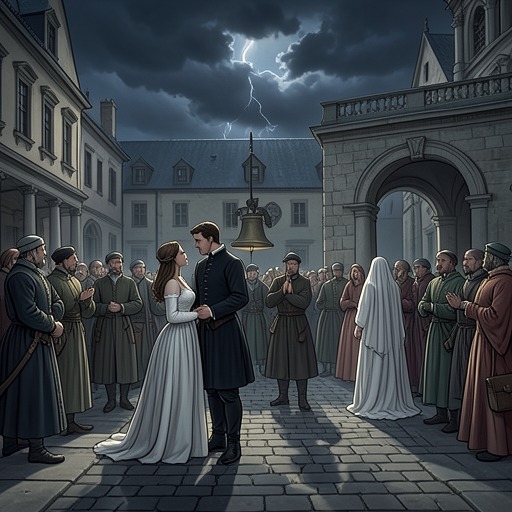
The consequence is severe. Hero is accused, scorned, and dishonored; the wedding is disrupted, and her grief is understood by those around her as causing her sudden death. The Sexton’s report confirms that Don John has secretly fled, that Hero was accused and refused in this manner, and that she has died from the grief of the event. Don Pedro is thus connected to a judgment whose consequences extend beyond embarrassment: his mistaken confidence helps produce the apparent death of an innocent woman and the collapse of Leonato’s household’s honor.
Recognition and Moral Reckoning
Don Pedro’s movement toward recognition begins when Borachio is brought before him and Claudio. Borachio refuses to soften his confession and declares that he deceived their very eyes. He explains that Don John incensed him to slander Hero, that the prince and Claudio saw him court Margaret in Hero’s garments, and that Hero was disgraced when she should have been married. He also states that the night watch overheard his confession, so that the truth was uncovered not by the prince’s wisdom but by the supposedly shallow constables.
This revelation forces Don Pedro to confront the limits of his authority and perception. The watchmen’s accidental discovery overturns the prince’s earlier visual certainty. What seemed to be knowledge was only a staged likeness; what seemed socially inferior proves capable of correcting the judgment of powerful men. Don Pedro’s position does not protect him from misinformation, and the exposure of the plot makes his earlier participation in Hero’s humiliation morally consequential even though he did not design the fraud.
The discovery also reconnects Don Pedro with the larger pattern of information in the play. Don John’s conspiracy moves from secret intention to arranged spectacle, from spectacle to authoritative misreading, and finally from confession to public correction. Don Pedro stands at the center of this circulation: he receives, validates, and helps transmit the false appearance, then witnesses its disproof. His arc is therefore less a triumph of flawless princely judgment than a demonstration that rank cannot substitute for verification.
Relationships and Narrative Role
Don Pedro’s relation to Claudio is both affectionate and managerial. He supports Claudio’s love for Hero, offers to woo her on Claudio’s behalf, and later joins Claudio in the orchard deception because he believes the evidence presented to him. Their partnership gives Claudio access to princely authority while giving Don Pedro a younger companion whose marriage becomes one of the prince’s principal projects. When Claudio’s conduct produces catastrophe, however, Don Pedro’s association with him binds the prince to the consequences of that conduct.
His relation to Benedick and Beatrice is more openly comic and constructive. Don Pedro treats their hostility as a problem to be solved through collaboration, and he recruits Leonato and Claudio to help create the conditions for mutual recognition. Benedick’s refusal to speak with Beatrice is so emphatic that he would rather undertake an errand to the Antipodes, fetch a tooth-picker from the furthest inch of Asia, bring the length of Prester John’s foot, or remove a hair from the great Cham’s beard than hold three words of conference with her. Don Pedro’s matchmaking scheme turns that extravagant refusal into the starting point for a new attachment.
Beatrice’s language later exposes the limits of the male world Don Pedro represents. After Hero’s disgrace, she declares that she wishes she were a man so that she could answer Claudio’s wrong with direct violence, even imagining eating his heart in the marketplace. She laments that manhood has melted into courtesies and valour into compliment. Benedick responds by pledging love to her and agreeing to challenge Claudio. Don Pedro is not the direct object of this anger, but the crisis occurs within the courtly system he helps govern, a system whose ceremonious language has failed to protect Hero and whose men must decide whether honor will remain verbal or become action.
Change, Ending, and Significance
By the end of the supplied action, Don Pedro remains a prince, but the meaning of his authority has changed. Earlier, his confidence helps initiate courtship and sustain a deceptive accusation; later, the confession of Borachio and the watchmen’s evidence compel him to acknowledge that official judgment can be defeated by poor but attentive observers. His power is repeatedly shown as relational: it depends on the people he trusts, the scenes he stages, and the reports he accepts.
The final exchange with Benedick gives Don Pedro a lighter but revealing afterimage. Benedick, now intending to marry Beatrice, refuses to be mocked out of his new humor by a college of wit-crackers. He declares that he will no longer care what the world says against marriage, and he asks Claudio to live unbruised and love Beatrice’s cousin. The prince’s teasing world of wit has not disappeared, but Benedick’s transformation shows that Don Pedro’s social machinery has produced a durable change rather than merely another jest.
Don Pedro is consequently a mediating figure whose strengths and failures arise from the same source. He understands people well enough to arrange their encounters, animate their desires, and turn social friction toward comedy. Yet he also trusts the visible scene too readily when a malicious director controls it. His narrative importance lies in that tension: he is both maker and misreader of appearances, an agent of reconciliation who must pass through the consequences of credulity before the play can restore honor and communal order.